
The Relationship Between Healthcare Expenditure and Life Expectancy
Introduction
This project investigates how healthcare spending and economic conditions are linked to life expectancy across different countries. With rising healthcare costs and aging populations worldwide, it is increasingly important to understand how healthcare investment relates to population health.
Earlier studies have found similar patterns. For instance, Nixon and Ulmann showed that higher healthcare spending is linked to better health outcomes in OECD countries. Likewise, Jakovljevic et al. found a positive association between healthcare expenditure and life expectancy in BRICS countries. However, many of these studies focus on specific regions. In contrast, this project uses cross-country data to provide a broader comparison.
Data
The data used in this project comes from Our World in Data, which offers global information on healthcare spending, income levels, and life expectancy.
- Life Expectancy: The outcome variable, measured in years.
- Healthcare Expenditure: Government health spending as a share of GDP.
- GDP per Capita: Income per person, adjusted for purchasing power.
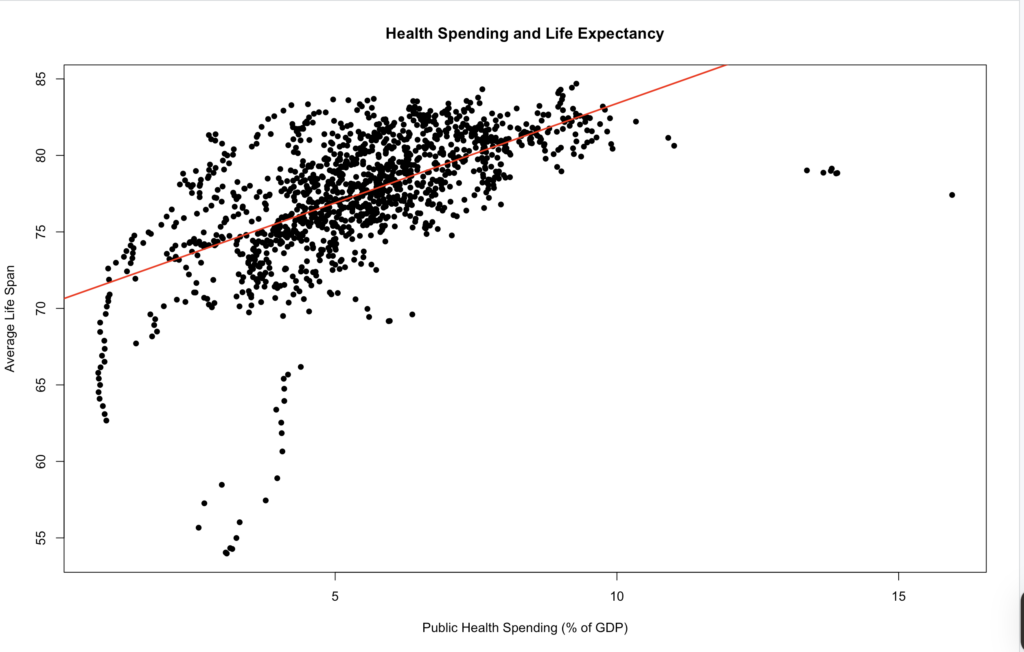
The scatter plot illustrates a general upward trend between healthcare spending and life expectancy. Countries that allocate a larger share of GDP to healthcare tend to achieve higher life expectancy. At the same time, the spread of points suggests that additional factors may also influence health outcomes.
Method
To examine these relationships, a multiple regression model is used:
Life Expectancy = β0 + β1 × Healthcare Expenditure + β2 × GDP per Capita + ϵ
where:
- β0 represents the baseline level of life expectancy
- β1 captures the relationship between healthcare spending and life expectancy
- β2 measures the association between income and life expectancy
- ϵ represents other unexplained factors
This approach allows us to evaluate the relationship between healthcare investment, economic development, and life expectancy.
| Variable | Estimate | Std. Error | T-value | P-value |
| Intercept | 69.91 | 0.253 | 276.08 | < 2e-16 |
| Healthcare Expenditure | 0.814 | 0.053 | 15.39 | < 2e-16 |
| GDP per Capita | 0.0000904 | 0.00000566 | 15.98 | < 2e-16 |
| Number of Observations | 1342 | |||
| R-Squared | 0.464 |
Interpretation of Coefficients
Healthcare Expenditure: The estimated coefficient is 0.814, indicating that an increase in healthcare spending (as a share of GDP) is associated with a rise in life expectancy of about 0.814 years, holding other variables constant.
GDP per Capita: The coefficient for GDP per capita is positive (0.0000904), suggesting that countries with higher income levels tend to have higher life expectancy. The small value reflects the large scale of the GDP variable.
Hypothesis Testing
Both explanatory variables are highly significant, with p-values below 0.001. This indicates that the observed relationships are statistically meaningful.
The model explains approximately 46.4% of the variation in life expectancy, based on the R-squared value. While this is a considerable proportion, it also implies that other important factors—such as education, environmental conditions, and healthcare systems—are not included in the model.
Conclusion
The results suggest that both healthcare expenditure and GDP per capita are positively related to life expectancy across countries. In general, higher levels of healthcare spending and economic development are associated with longer life expectancy. However, this analysis does not account for all possible influences on health outcomes. Future research could include additional variables, such as education, environmental quality, and lifestyle factors, to provide a more complete understanding. Overall, this study highlights the role of both healthcare investment and economic conditions in shaping population health.